Selecting the correct tubing is often the difference between a smooth operation and a costly system failure. While silicone tubing is renowned for its flexibility and thermal stability, not all silicone is created equal.
For procurement officers and engineers, the challenge lies in navigating the specifications. Whether you are designing a medical device or a food processing line, understanding the nuances of material grades, hardness, and dimension is essential.
In this guide, we break down the critical factors to help you select the perfect Silicone Tubing for your specific application.

1. Material Composition & Curing Methods
The first step in selection is understanding the "recipe" of the silicone. The curing process determines the purity and physical properties of the tube.
Platinum-Cured vs. Peroxide-Cured
Platinum-Cured Silicone: This is the gold standard for high-purity applications. It has fewer by-products, higher clarity, and no taste or odor. It is essential for medical grade silicone tubing and sensitive food applications.
Peroxide-Cured Silicone: Generally more cost-effective and offers longer mechanical life (better compression set). It is widely used in industrial applications where high purity is not the primary concern.
2. Key Performance Factors
When reviewing a datasheet or requesting a quote for custom silicone tubing, pay close attention to these three pillars:
Temperature Resistance
One of silicone’s greatest strengths is its thermal range. Standard silicone can typically withstand temperatures from -60°C to 200°C (-76°F to 392°F).
Chemical Compatibility
Silicone is chemically inert to many substances, but it is not a "catch-all" solution.
Good Resistance: Water, ozone, UV light, low-concentration acids, and bases.
Poor Resistance: Concentrated acids, oils, fuels (gasoline/diesel), and ketone solvents.
Engineering Note: For applications involving oils, consider asking for Fluorosilicone options.
Durometer (Hardness)
Silicone hardness is measured on the Shore A scale.
50 Shore A: Soft and highly flexible. Ideal for peristaltic pumps where the tube needs to be compressed repeatedly.
70 Shore A: Standard hardness. Offers a balance of flexibility and pressure resistance.
80+ Shore A: Stiff and rigid. Used for high-pressure applications.
Need specific specs?Check our full Silicone Tubing Product List to find the right grade and size for your project.
3. Matching the Tubing to the Application
Different industries have strict regulatory requirements. Choosing the wrong grade can lead to compliance failures.
Medical & Pharmaceutical: Must meet USP Class VI and ISO 10993 standards. The tubing must be biocompatible and capable of sterilization (Autoclave/Gamma).
Food & Beverage: Must comply with FDA 21 CFR 177.2600. Food grade silicone tubing ensures that the transfer of milk, beer, or water does not pick up any plastic taste.
Industrial: Focuses on mechanical durability and electrical insulation. Often used for cable jacketing or coolant transfer.
4. Common Selection Mistakes to Avoid
Even experienced engineers can overlook details. Here are common pitfalls:
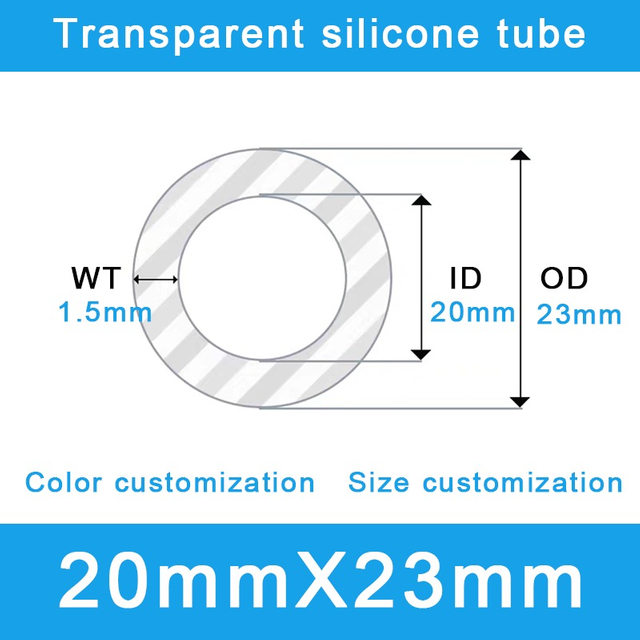
Ignoring Wall Thickness: Focusing only on the Inner Diameter (ID) for flow rate is a mistake. The wall thickness determines the tubing's ability to handle pressure and vacuum. A wall that is too thin will kink or collapse.
Overlooking Bend Radius: If your installation requires tight turns, a standard tube might kink, blocking flow. You may need reinforced silicone hose for tighter bend radii.
Neglecting Sterilization Methods: Not all silicone grades handle repeated steam sterilization equally. Ensure your material matches your cleaning cycle.
5. Selection Checklist: Before You Order
To speed up your sourcing process, have the following information ready when contacting a manufacturer:
Application: What fluid or gas is being transported?
Environment: What is the operating temperature and pressure?
Dimensions: Required ID, OD, and Wall Thickness.
Compliance: Do you need FDA, USP, or UL certification?
Volume: Do you need a standard roll or custom cut-to-length pieces?

Frequently Asked Questions (FAQ)
Q: How do I measure the size of silicone tubing I need?
A: You need to measure the Inner Diameter (ID) for the flow of liquid and the Outer Diameter (OD) to ensure it fits your connectors. Wall thickness is calculated as (OD - ID) / 2.
Q: Can silicone tubing handle high pressure?
A: Standard unreinforced silicone tubing is designed for low-pressure applications. For high-pressure systems, you should choose braided reinforced silicone hose, which has polyester or fiberglass reinforcement.
Q: Is silicone tubing compatible with peristaltic pumps?
A: Yes, but you must choose a specific formulation designed for high pump life. Standard silicone may fatigue and crack (spallation) too quickly. Look for "pump grade" silicone.
Q: Do you offer custom colors or sizes?
A: Yes, as a manufacturer, we can produce custom silicone tubing in specific Pantone colors, hardness levels, and non-standard sizes to fit your equipment.